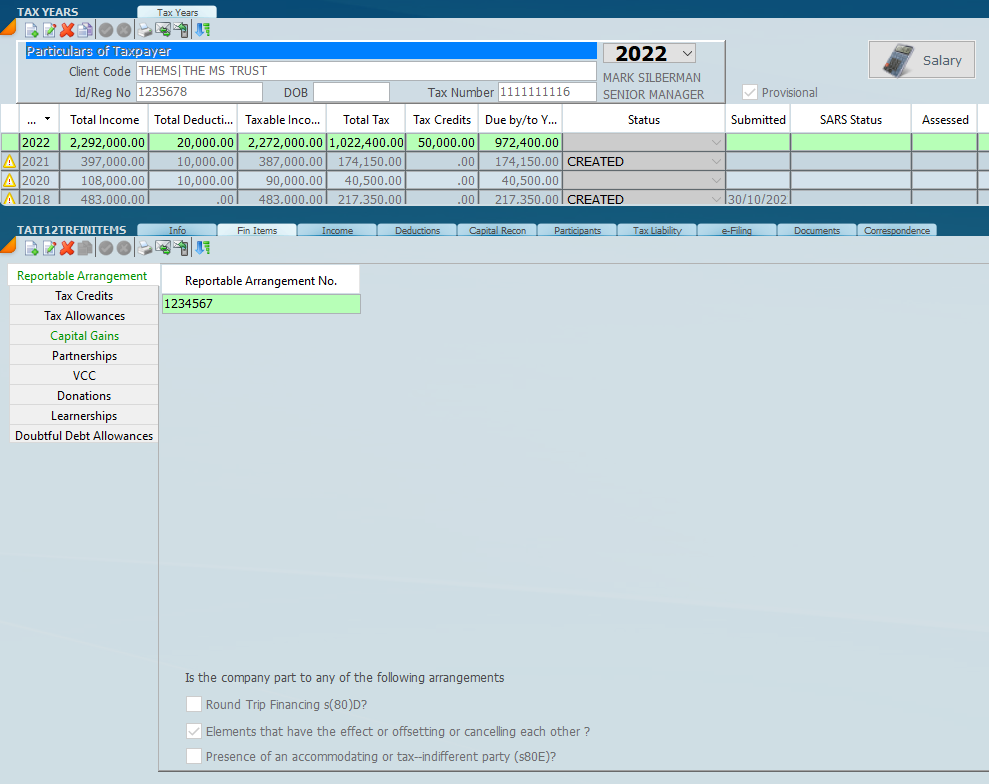
IT12 Trust Reportable Arrangement
If there is a reportable arrangement the following screen must be entered, otherwise don't enter.
Yes. A trust can be a “participant” in a reportable arrangement and will then have a mandatory disclosure obligation under sections 34–39 of the Tax Administration Act (TAA).
## 1) What is a “reportable arrangement” (TAA s34–36)?
- “Reportable arrangement” means an arrangement referred to in TAA s35(1) or s35(2) that is not an excluded arrangement under s36.
- “Participant” (who must disclose) includes:
- the promoter;
- a person who will (directly or indirectly) derive a tax benefit or financial benefit from the arrangement; or
- a person party to an arrangement listed by the Commissioner in a public notice under s35(2).
- A “tax benefit” is the avoidance, postponement, reduction or evasion of a liability for tax.
### When is an arrangement reportable? (TAA s35)
An arrangement is reportable if a participant is involved and it meets any of the s35(1) triggers, for example:
- fees/interest/finance costs depend (wholly/partly) on assumptions about the tax treatment of the arrangement;
- it has characteristics contemplated in ITA s80C(2)(b) (or substantially similar);
- it creates a book/tax mismatch (deduction for Income Tax but not an expense for financial reporting, or vice versa);
- it lacks a reasonable expectation of pre-tax profit, or the pre-tax profit is less than the present value of the tax benefit.
It is also reportable if the Commissioner lists it in a public notice under s35(2).
### Excluded arrangements (TAA s36)
Certain arrangements may be excluded (e.g. certain stand-alone debts, leases, regulated exchange transactions, CIS transactions), but exclusions do not apply if the arrangement is entered into mainly to obtain/enhance a tax benefit or structured to enhance a tax benefit.
## 2) Disclosure obligation and time limits (TAA s37)
- A participant must disclose the prescribed information within 45 business days:
- after the arrangement qualifies as reportable (if already a participant), or
- after becoming a participant (if joining later).
- SARS may grant an extension of a further 45 business days if reasonable grounds exist.
- A participant need not disclose if it obtains a written statement from another participant confirming that the other participant has disclosed the reportable arrangement.
## 3) What information must be submitted? (TAA s38–39)
The disclosure must include (in the prescribed form/manner and by the specified date), among other items:
- a detailed description of all steps and key features;
- a description of the assumed tax benefits;
- names/registration numbers/addresses of all participants;
- a list of agreements; and
- any financial model reflecting the projected tax treatment.
After SARS receives the information, SARS must issue a reportable arrangement reference number to each participant (for administrative purposes).
## 4) Penalties for non-disclosure (TAA s212)
If a participant/promoter fails to disclose as required by s37, SARS may impose a monthly penalty (up to 12 months):
- R50,000 per month (non-promoter participant/intermediary), or
- R100,000 per month (promoter).
This can be doubled if the anticipated tax benefit exceeds R5 million and tripled if it exceeds R10 million.
## 5) Trust return (ITR12T) – where it appears
SARS’ trust return guide confirms that trusts must answer whether the trust entered into a reportable arrangement in terms of TAA ss34–39, and if “Yes” the trust must complete the “Reportable Arrangement” section and capture the reportable arrangement number/reference number issued by SARS.
The guide also flags features/questions such as round trip financing (s80D), offsetting/cancelling elements, and accommodating/tax-indifferent parties (s80E).
12 May 2026